
About the Percentage Calculator
This free percentage calculator answers the question people look up most: what is X% of Y. Enter the percentage and the value, and you get the answer instantly — no formula to remember and no mental arithmetic.
It comes up constantly. A 15% service charge on a bill, 18% GST on a quote, an 8% salary hike, 12% interest on a deposit, 40% off in a sale. Same calculation, different context every time.
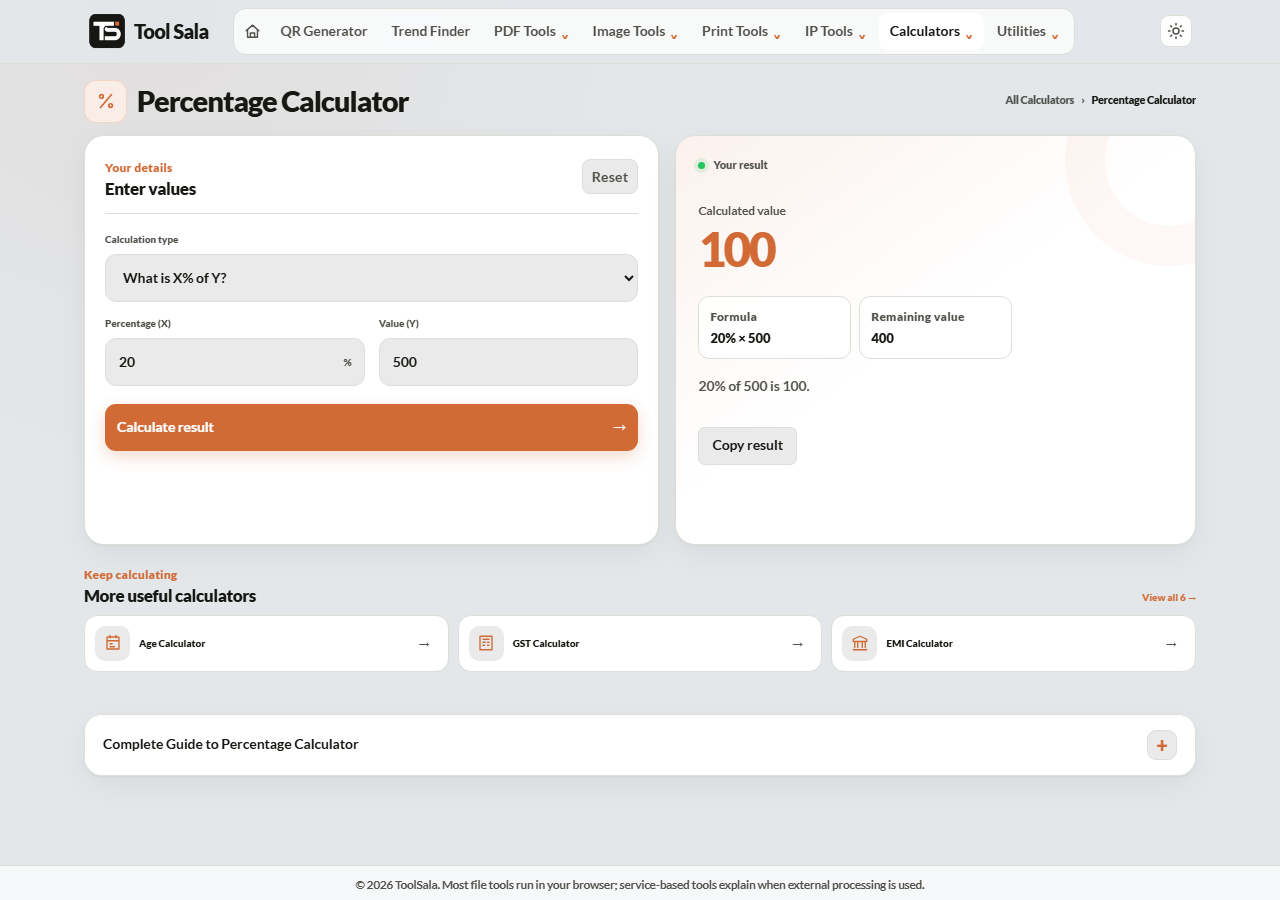
How to calculate a percentage
- Enter the Percentage (X) — for example 18.
- Enter the Value (Y) — the amount you are taking the percentage of.
- Click Calculate result.
- Use Copy result to paste the answer somewhere.
The formula, and the shortcuts
The arithmetic is simply X% of Y = (X ÷ 100) × Y. So 18% of 2,500 is 0.18 × 2,500 = 450.
Three shortcuts worth knowing for quick mental checks:
- 10% — move the decimal one place left. 10% of 2,500 is 250.
- 5% — half of 10%. So 125.
- 1% — move the decimal two places left. So 25.
Build any percentage from those. 18% is 10% + 5% + 1% + 1% + 1% = 250 + 125 + 75 = 450. Same answer.
The mistake almost everyone makes
A percentage increase and the matching decrease are not the same size. Take 1,000:
- Add 20% → 1,200.
- Now take 20% off 1,200 → 960, not 1,000.
The second percentage is calculated on a bigger number, so it removes more. This is why a price that rises 20% and later falls 20% ends up lower than where it started — and why “50% off, then 20% off” is never 70% off.
Percentage change between two numbers
To find how much something grew or shrank, use ((new − old) ÷ old) × 100. Sales going from 40,000 to 52,000 is a rise of 12,000 on 40,000, which is 30%. Always divide by the original number — dividing by the new one is the most common error in this calculation.
Percentage Calculator FAQs
Is this percentage calculator free?
Yes. No signup, no limit, and it works on phone and desktop.
How do I find what percentage one number is of another?
Divide the part by the whole and multiply by 100. For 45 marks out of 60: (45 ÷ 60) × 100 = 75%.
How do I calculate a percentage increase?
Subtract the old value from the new one, divide by the old value, then multiply by 100. Going from 500 to 650 is a 30% increase.
Why is a 20% rise then a 20% fall not back to the start?
Because the fall is calculated on the higher number. 1,000 plus 20% is 1,200; 20% off 1,200 is 960.
Can I use it for marks and results?
Yes. Divide marks obtained by total marks and multiply by 100 to get the percentage.
Is anything I type saved?
No. The calculation runs in your browser and nothing is sent to a server.
Related online tools
- Discount Calculator — apply a discount and then add tax.
- GST Calculator — add or remove GST at the standard Indian rates.
- EMI Calculator — monthly instalment and total interest on a loan.
- SIP Calculator — what a monthly investment could grow to.
- All calculators — the full list.